
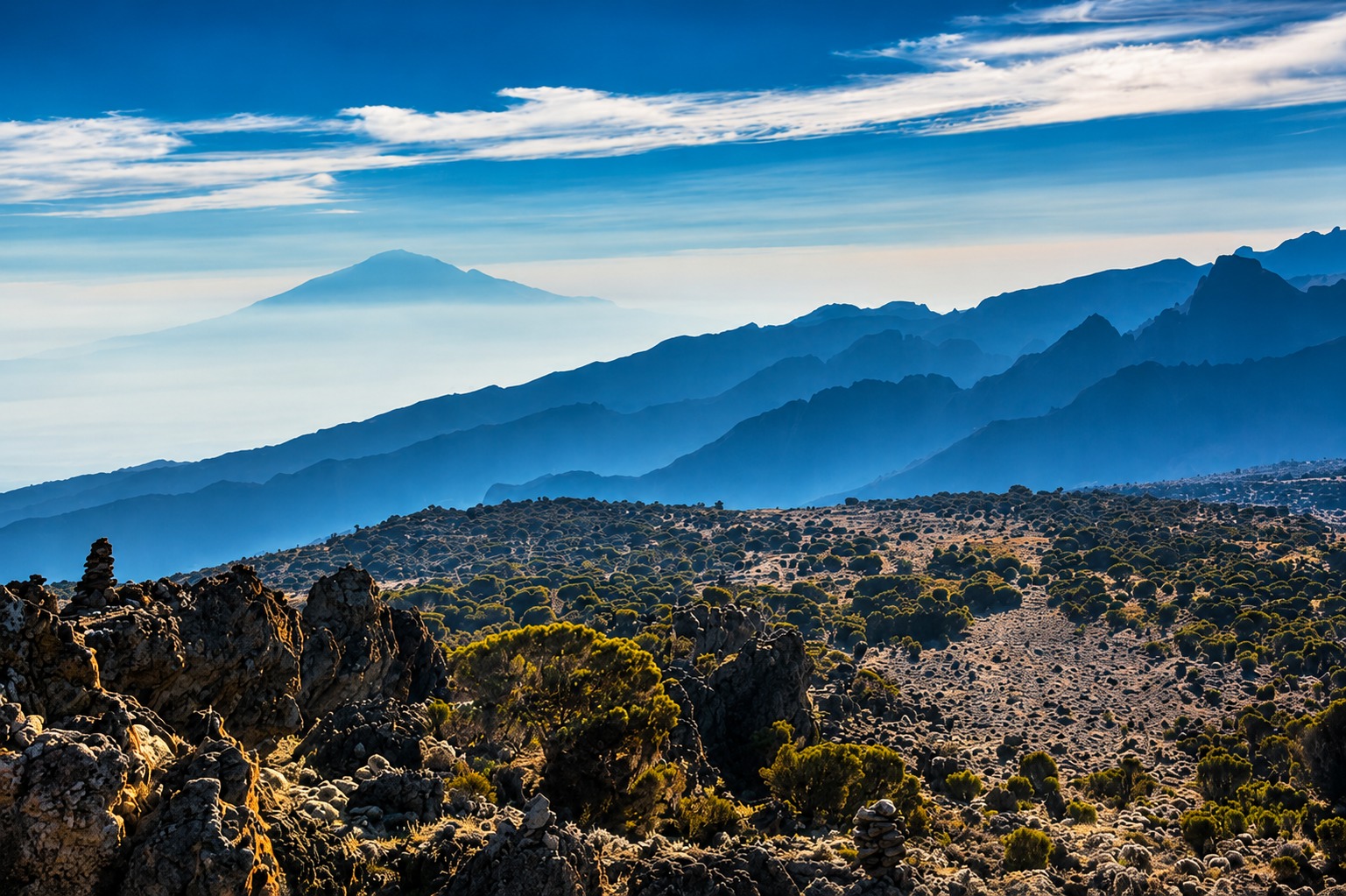
The Budget 6 Days Kilimanjaro Machame Route Group Join is designed for travellers seeking an affordable, professionally organized climb with fixed departure dates and shared expedition services.
The climb begins at Machame Gate on Kilimanjaro's southern slopes. The route rises through rainforest, heath, moorland, Shira Plateau, alpine desert, and the arctic summit zone before descending through Mweka.
The Machame Route is commonly known as the Whiskey Route. It is popular for its dramatic scenery, varied terrain, established camps, Lava Tower acclimatization stage, and the famous Barranco Wall.
On the six-day itinerary, climbers do not sleep at Karanga Camp. After climbing the Barranco Wall, the group crosses Karanga Valley and continues directly to Barafu Camp. This creates a longer day immediately before the summit attempt.
A group joining climb brings together travellers who have booked the same scheduled departure. Participants share guides, assistant guides, cooks, porters, tents, meals, transport, and other expedition services.
6 Days Budget Machame Climb at a Glance
Why Choose the Budget 6-Day Machame Route?
Lower Overall Cost
One fewer mountain day can reduce park, crew, meal, and logistical expenses.
Shorter Time Commitment
Suitable for travellers who cannot commit to a seven- or eight-day mountain itinerary.
Scenic Route
The climb still includes Shira Plateau, Lava Tower, Barranco Wall, and the southern circuit.
Group Savings
Joining other climbers allows selected expedition costs to be shared.
Scheduled Departures
Fixed dates make it easier for solo travellers to join an organized climb.
Different Descent Route
The group descends through Mweka instead of returning by the ascent trail.
International Group
Meet travellers from different countries during a shared mountain adventure.
Professional Support
Licensed guides, cooks, porters, and ground staff support the expedition.
6-Day vs 7-Day Machame Route
| Comparison | 6-Day Machame | 7-Day Machame |
|---|---|---|
| Mountain duration | Six trekking days | Seven trekking days |
| Karanga overnight | No separate overnight | Yes |
| Barranco stage | Barranco to Barafu through Karanga | Barranco to Karanga |
| Following stage | Summit attempt after longer approach | Karanga to Barafu before summit night |
| Acclimatization time | Less | More |
| Recovery time | More limited | Better distributed |
| Typical price | Lower | Higher |
| Best suited to | Fit, time-limited, budget-conscious climbers | Climbers prioritizing acclimatization |
| Recommended when possible | Suitable under the right circumstances | Generally the more gradual option |
Why Join a Budget Kilimanjaro Group?
Share Expedition Costs
Guides, transport, camp infrastructure, cooking, and organizational costs are shared within the group.
Ideal for Solo Travellers
Book one place without paying the full cost of a private expedition.
Social Experience
Share the challenge, meals, camps, and summit journey with other participants.
Fixed Departure Dates
Scheduled departures provide a clear plan for flights and accommodation.
Group Motivation
Encouragement from other climbers can help during difficult trail sections.
Professional Team
The group is supported by licensed mountain guides, cooks, and porters.
6-Day Machame Route Flow
Complete 6 Days Machame Route Itinerary
Machame Gate to Machame Camp
After breakfast at the hotel, the group travels to Machame Gate. The journey passes through villages and agricultural areas on the lower slopes of Kilimanjaro.
At the gate, the guide completes registration, permit checks, luggage weighing, porter organization, and other expedition procedures.
The trail begins inside Kilimanjaro's dense rainforest. Conditions may be humid, muddy, wet, and slippery, particularly during rainy periods.
Climbers should keep waterproof clothing accessible rather than packing it inside the porter-carried duffel. Trekking poles can provide stability on wet and uneven ground.
The group walks slowly through tall forest vegetation, moss-covered trees, ferns, and possible monkey habitat. Wildlife sightings are possible but never guaranteed.
On arrival at Machame Camp, the crew normally has the tents prepared. Climbers change into dry and warm clothing, organize personal equipment, eat dinner, and attend the evening briefing.
Day One Highlights
- Meeting the mountain crew
- Machame Gate registration
- Rainforest trekking
- Introduction to the “pole pole” pace
- First night in a mountain tent
Meals: Lunch and dinner, or according to the confirmed package.
Accommodation: Mountain tent at Machame Camp.
Machame Camp to Shira Camp
The second day leaves the rainforest and enters the heath and moorland zone. Vegetation becomes shorter as the route gains elevation.
The trail can be steep, rocky, and exposed. Although the trekking distance is not extremely long, the elevation gain makes slow pacing important.
When weather conditions are clear, climbers may see Kibo, Mount Meru, Shira Ridge, and the plains below.
The group crosses volcanic terrain and reaches the Shira Plateau. Afternoon cloud, wind, rain, or cold may develop quickly.
At Shira Camp, climbers should change into warm layers, hydrate, eat properly, and rest. The guide may organize a short acclimatization walk if time and group health allow.
Day Two Highlights
- Leaving the rainforest
- Entering heath and moorland
- Views of Kibo when clear
- Reaching Shira Plateau
- Sleeping near 3,800 metres
Meals: Breakfast, lunch, and dinner.
Accommodation: Mountain tent at Shira Camp.
Shira Camp to Lava Tower and Barranco Camp
This is the most important acclimatization stage of the six-day Machame Route. The group climbs through increasingly dry volcanic terrain toward Lava Tower.
Lava Tower stands at approximately 4,600 metres. Climbers may stop near the formation for lunch, rest, and altitude exposure.
Some participants may experience headache, nausea, reduced appetite, tiredness, or dizziness at this elevation. Every symptom should be reported to the guides immediately.
After Lava Tower, the route descends into Barranco Valley. This creates a climb-high and sleep-lower pattern that can support acclimatization.
The trail passes distinctive high-altitude vegetation, including giant groundsels, before reaching Barranco Camp beneath the Barranco Wall.
Day Three Highlights
- Reaching approximately 4,600 metres
- Lava Tower volcanic landscape
- Climb-high and sleep-lower profile
- Descent into Barranco Valley
- First view of the Barranco Wall
Meals: Breakfast, lunch, and dinner.
Accommodation: Mountain tent at Barranco Camp.
Barranco Camp to Barafu Camp via Karanga Valley
Day four distinguishes the six-day Machame itinerary from the seven-day version. The group must climb the Barranco Wall, cross several valleys and ridges, pass Karanga, and continue to Barafu Camp.
The day begins with the Barranco Wall. Although the wall can appear intimidating from camp, it is normally completed as a steep trek and scramble rather than a technical rock climb.
Climbers may use their hands for balance in selected sections. The guide controls the pace and helps the group move through narrow or exposed points.
After reaching the top of the wall, the route crosses undulating terrain before descending into Karanga Valley. The group then climbs out of the valley and passes the Karanga Camp area.
Seven-day groups normally stop and sleep at Karanga. On the six-day itinerary, participants continue toward Barafu Camp.
The final approach becomes increasingly dry, rocky, and exposed. The altitude, accumulated distance, and repeated climbing make this a demanding day.
On arrival at Barafu, climbers have limited time to eat, organize summit equipment, receive the final briefing, and rest before the nighttime summit departure.
Summit Preparation Checklist
- Thermal base layers
- Warm fleece or mid layer
- Insulated summit jacket
- Waterproof outer layers
- Warm hat and neck protection
- Insulated gloves
- Headlamp with spare batteries
- Trekking poles
- Water protected against freezing
- High-energy summit snacks
Meals: Breakfast, lunch, and early dinner.
Accommodation: Mountain tent at Barafu Camp.
Barafu Camp to Uhuru Peak and Mweka Camp
The summit attempt normally begins around midnight. The group leaves Barafu in darkness and climbs slowly toward Stella Point.
The trail is steep, cold, and physically demanding. Climbers may encounter loose scree, frozen ground, strong wind, snow, or rapidly changing weather.
The guide sets a slow pace to conserve energy and monitor the group. Participants should avoid racing or following faster climbers outside the guide's instructions.
Stella Point is located on Kilimanjaro's crater rim at approximately 5,756 metres. Climbers who remain healthy and receive guide approval continue toward Uhuru Peak.
The final crater-rim section may appear gradual, but the extreme altitude makes each step difficult. Glaciers and summit ice may be visible when weather conditions allow.
Uhuru Peak stands at 5,895 metres and is the highest point in Africa. The summit stay is normally brief because of cold, wind, altitude, congestion, and group health.
After photographs, the group descends to Barafu Camp. The downhill trail can place considerable pressure on the knees, feet, and legs.
Climbers rest briefly at Barafu, collect equipment, eat, and continue descending toward Mweka Camp. The lower elevation may feel warmer, but summit day remains extremely long.
Summit Day Milestones
- Midnight departure
- Steep ascent through scree
- Arrival at Stella Point
- Crater-rim walk
- Uhuru Peak at 5,895 metres
- Descent to Barafu
- Continuation to Mweka Camp
Meals: Early breakfast or snacks, lunch, and dinner.
Accommodation: Mountain tent at Mweka Camp.
Mweka Camp to Mweka Gate
After breakfast, the group descends through Kilimanjaro's rainforest toward Mweka Gate.
The trail may be wet, muddy, and slippery. Climbers should continue using trekking poles and avoid rushing despite being close to the end.
At Mweka Gate, the guide completes park exit procedures. Summit certificates may be issued according to the highest officially recognized point reached.
The group meets the transfer vehicle and returns to the hotel for showers, rest, equipment organization, and celebration.
Day Six Highlights
- Final rainforest descent
- Completion of the Machame Route
- Park exit procedures
- Certificate arrangements
- Return transfer to the hotel
Meals: Breakfast and lunch, depending on the package.
Accommodation: Hotel if included in the confirmed package.
Daily Elevation and Walking Time
| Day | Route | Approximate Elevation | Estimated Time | Environment |
|---|---|---|---|---|
| Day 1 | Machame Gate to Machame Camp | 1,800 m to approximately 2,835–3,000 m | 5–7 hours | Rainforest |
| Day 2 | Machame Camp to Shira Camp | Approximately 3,000 m to 3,750–3,840 m | 4–6 hours | Heath and moorland |
| Day 3 | Shira to Lava Tower to Barranco | Approximately 3,800 m to 4,600 m to 3,950 m | 6–8 hours | Alpine desert and valley |
| Day 4 | Barranco via Karanga to Barafu | Approximately 3,950 m to 4,673 m | 7–9 hours | Wall, valleys, and alpine desert |
| Day 5 | Barafu to Uhuru Peak to Mweka | Approximately 4,673 m to 5,895 m to 3,100 m | 12–16 hours | Arctic summit and descent |
| Day 6 | Mweka Camp to Mweka Gate | Approximately 3,100 m to 1,640 m | 3–5 hours | Rainforest |
Budget Package Price
Per person sharing, based on the confirmed departure date, group size, hotel arrangement, and package inclusions.
Price May Depend On
- Confirmed group size
- Departure season
- Hotel category
- Airport-transfer arrangements
- Single-room request
- Single-tent request
- Equipment rental
- Portable toilet service
- Extra hotel nights
- Safari or Zanzibar extension
How the Budget Package Reduces Cost
What's Included
Mountain Services
- Licensed Kilimanjaro lead guide
- Assistant guides according to group size
- Mountain cooks
- Porters within permitted load limits
- National park entry arrangements
- Machame Route camping arrangements
- Rescue-charge arrangements where applicable
- Mountain sleeping tents
- Shared dining arrangement
- Cooking equipment
- First-aid supplies
Meals and Transfers
- Meals during the mountain climb
- Treated or boiled drinking water
- Transfer from hotel to Machame Gate
- Transfer from Mweka Gate to hotel
- Pre-climb briefing
- Basic equipment inspection
- Health monitoring by the guide team
- Emergency oxygen where specified
- Summit-certificate arrangements
- Government taxes where expressly included
What's Not Included
Travel and Personal Costs
- International flights
- Domestic flights unless specified
- Tanzania visa
- High-altitude travel insurance
- Personal medical expenses
- Vaccinations
- Personal trekking equipment
- Equipment rental unless stated
- Personal snacks and drinks
- Laundry and telephone expenses
Optional and Additional Services
- Tips for guides, cooks, and porters
- Single-room supplement
- Single mountain tent supplement
- Portable private toilet
- Extra hotel accommodation
- Private airport transfers
- Safari extensions
- Zanzibar extensions
- Mount Meru acclimatization climb
- Items not listed under inclusions
Group Joining Information
Group Size
The final number depends on confirmed bookings, guide ratios, permits, season, and company policy.
Solo Travellers
Solo climbers can join without arranging a complete private expedition.
Shared Itinerary
All participants follow the same camps, meal schedule, and general route plan.
Walking Pace
Guides set a slow group pace and may divide climbers between guides when staffing allows.
Tent Sharing
Two participants normally share one mountain tent unless a single supplement is confirmed.
Room Sharing
Hotel prices may be based on twin sharing. Solo rooms may require an additional charge.
Accommodation on the Machame Route
Machame is a camping route. The package uses official public campsites inside Kilimanjaro National Park.
Sleeping Tents
Standard mountain tents are commonly shared by two climbers.
Sleeping Bags
Climbers normally bring or rent an appropriately rated sleeping bag.
Sleeping Mats
Basic sleeping mats may be supplied according to the final package.
Dining Tent
Meals are usually served inside a shared group dining shelter.
Camp Toilets
Public toilets are basic. Portable toilets may cost extra.
No Showers
Full showers are not normally available during the climb.
Mountain Meals
| Meal | Possible Examples | Notes |
|---|---|---|
| Breakfast | Porridge, eggs, bread, fruit, pancakes, tea, coffee, or hot chocolate | Eat adequately even when appetite is reduced. |
| Lunch | Sandwiches, soup, rice, pasta, potatoes, fruit, eggs, or packed lunch items | Lunch style depends on the trekking day. |
| Dinner | Soup, rice, pasta, vegetables, potatoes, meat, stew, fruit, or dessert | Dinner supports recovery for the next day. |
| Summit Snacks | Energy bars, sweets, biscuits, gels, nuts, or personal snacks | Bring familiar snacks that remain edible in cold weather. |
| Drinking Water | Treated or boiled mountain water | Follow the guide's hydration instructions. |
Difficulty of the 6-Day Machame Route
The six-day Machame Route is a challenging high-altitude trek. Its difficulty comes from altitude, steep terrain, repeated elevation changes, cold, camping, long days, and limited recovery before the summit attempt.
Fast Itinerary
The route reaches extreme altitude over a relatively short period.
Barranco to Barafu
The long fourth day combines the wall, Karanga Valley, and Barafu approach.
Summit Night
Climbers begin another long stage after limited rest at Barafu.
Long Descent
Summit day continues down to Mweka Camp after reaching the crater rim.
Acclimatization Profile
The six-day Machame itinerary includes useful altitude variation, particularly the ascent to Lava Tower followed by descent to Barranco.
However, the itinerary does not include a separate Karanga overnight and therefore provides less time for acclimatization than the seven-day version.
Who Should Consider Seven Days Instead?
- First-time high-altitude trekkers
- Climbers without previous experience above 4,000 metres
- Travellers who can afford an additional mountain day
- People who recover slowly after long hikes
- Climbers prioritizing acclimatization over price
- Participants concerned about the long Barranco-to-Barafu day
- Older climbers seeking a more gradual itinerary
- Travellers with enough vacation time for a longer program
Altitude Sickness
Altitude illness can affect any climber, including fit, young, athletic, or experienced participants. Physical strength does not guarantee successful acclimatization.
Possible Early Symptoms
- Headache
- Nausea
- Dizziness
- Poor appetite
- Unusual fatigue
- Disturbed sleep
Serious Warning Signs
- Confusion
- Loss of coordination
- Breathlessness at rest
- Repeated vomiting
- Extreme weakness
- Unusual behaviour
Required Response
- Report symptoms immediately
- Do not hide illness
- Do not continue with worsening symptoms
- Follow guide instructions
- Accept descent when advised
- Do not pressure another climber
Safety Procedures
Licensed Guides
The expedition should be managed by licensed and experienced Kilimanjaro guides.
Daily Monitoring
Guides monitor symptoms, pace, appetite, hydration, and general condition.
Emergency Oxygen
Oxygen may be carried for emergency use according to the operator's safety plan.
First-Aid Equipment
The guide team should carry appropriate mountain first-aid supplies.
Guide Ratios
Adequate staffing allows groups to split when a climber needs to descend.
Emergency Descent
Descent is essential when serious altitude illness is suspected.
Weather Decisions
The guide may change timing or stop the ascent when conditions are unsafe.
Travel Insurance
Coverage should include trekking to Kilimanjaro's maximum altitude and emergency evacuation.
Physical Fitness Requirements
Participants should be able to walk for several consecutive days, climb steep terrain, carry a daypack, tolerate basic camping, and complete a long summit ascent and descent.
| Training Area | Recommended Activity | Purpose |
|---|---|---|
| Cardiovascular endurance | Walking, hiking, cycling, running, or swimming | Prepare for sustained mountain effort |
| Hill fitness | Outdoor hills, stairs, or inclined treadmill | Prepare for long elevation gains |
| Leg strength | Squats, lunges, step-ups, and calf raises | Support climbing and descending |
| Core strength | Planks and stability exercises | Improve balance and posture |
| Back-to-back hiking | Long hikes on consecutive days | Develop expedition recovery |
| Daypack training | Carry the expected personal pack weight | Prepare shoulders, back, and walking posture |
| Downhill practice | Controlled descents using trekking poles | Prepare for the long summit descent |
Recommended Packing List
Documents and Bags
- Passport
- Visa documentation
- Travel insurance details
- Medical information
- Soft-sided duffel bag
- Daypack
- Waterproof bag liners
- Dry bags
Footwear
- Waterproof trekking boots
- Camp shoes
- Trekking socks
- Warm summit socks
- Sock liners
- Gaiters
- Blister treatment
Upper-Body Clothing
- Moisture-wicking base layers
- Long-sleeved trekking shirts
- Warm fleece
- Insulated summit jacket
- Waterproof shell jacket
- Lightweight daytime layers
Lower-Body Clothing
- Trekking trousers
- Thermal leggings
- Waterproof trousers
- Warm summit trousers
- Underwear
- Optional hiking shorts
Head and Hands
- Sun hat
- Warm hat
- Buff or neck gaiter
- Sunglasses
- Lightweight gloves
- Insulated summit gloves
Sleeping Equipment
- Cold-rated sleeping bag
- Sleeping-bag liner
- Inflatable pillow
- Sleeping mat if not supplied
- Warm sleeping clothes
Hydration and Snacks
- Reusable water bottles
- Hydration bladder
- Insulated bottle cover
- Electrolyte products
- Energy bars
- Summit snacks
Personal Equipment
- Trekking poles
- Headlamp
- Spare batteries
- Power bank
- Charging cables
- Camera
Health and Hygiene
- Personal medication
- Sunscreen
- Lip balm
- Hand sanitizer
- Wet wipes
- Toilet paper
- Toothbrush and toothpaste
Best Time to Climb
| Period | General Conditions | Budget Group Notes |
|---|---|---|
| January to early March | Often relatively warm with generally favourable windows | Regular scheduled departures may be available |
| Late March to May | Long rains, mud, cloud, and wet camps | Fewer groups may operate |
| June to October | Main dry period with colder nights | Popular dates may fill early |
| November | Short-rain conditions and variable visibility | Confirm minimum participant requirements |
| December | Variable weather and holiday demand | Christmas and New Year prices may differ |
Kilimanjaro weather is unpredictable throughout the year. Climbers should prepare for rain, sunshine, wind, freezing temperatures, cloud, and possible snow during any departure.
Who Should Choose the 6-Day Budget Climb?
Budget Travellers
Suitable for climbers prioritizing a lower package price.
Time-Limited Visitors
Appropriate for travellers who cannot add another mountain day.
Fit Trekkers
Better suited to participants with strong hiking endurance.
Solo Travellers
Join a scheduled departure without arranging a private team.
Couples
Reserve two places while sharing the climb with other participants.
Small Groups
Friends can join a larger departure and share expedition costs.
Experienced Hikers
Previous multi-day trekking experience is useful.
Flexible Participants
Best for people comfortable with fixed dates and shared schedules.
Who Should Avoid the Faster Itinerary?
- Travellers with no hiking preparation
- People who recover slowly after long trekking days
- Climbers prioritizing maximum acclimatization time
- Participants concerned about the Barranco-to-Barafu day
- People with unresolved medical concerns
- Travellers who can comfortably afford a longer route
- Climbers wanting a private or highly flexible schedule
- Participants who prefer slower and shorter daily stages
Frequently Asked Questions
What is the six-day Machame Route?
It is a six-day Kilimanjaro itinerary that approaches from Machame Gate and descends through Mweka.
What makes it different from seven days?
The six-day version does not include a separate overnight at Karanga Camp.
Is the six-day route cheaper?
It is generally less expensive because it includes one fewer mountain day.
Is six days harder than seven days?
It is usually more demanding because of the faster schedule and longer Barranco-to-Barafu stage.
Is the six-day route recommended for beginners?
Fit and well-prepared beginners can attempt it, but seven days generally provides a more gradual schedule.
How high is Uhuru Peak?
Uhuru Peak reaches 5,895 metres or 19,341 feet.
Is technical climbing required?
No technical mountaineering skills are normally required on the standard Machame Route.
What is a group joining climb?
It is a scheduled departure where individual travellers share guides, crew, transfers, camps, and other services.
Can solo travellers join?
Yes. The package is well suited to solo travellers.
How large is the group?
The group size depends on bookings, guide ratios, season, permits, and company policy.
Will I share a tent?
Two climbers normally share a mountain tent unless a single supplement is booked.
Will I share a hotel room?
Budget prices may be based on twin sharing. A single-room supplement may apply.
Does Machame use huts?
No. Machame is a camping route.
Are showers available?
Full showers are normally unavailable on the mountain.
Are toilets available?
Public campsite toilets are available but basic. A portable private toilet may cost extra.
What is the Barranco Wall?
It is a steep trekking and scrambling section above Barranco Camp.
Is the Barranco Wall technical?
It is not normally considered a technical climb, but hands may be used for balance.
What is Lava Tower?
Lava Tower is a volcanic formation near 4,600 metres used as a high acclimatization point.
What does climb high and sleep lower mean?
It means reaching a higher elevation during the day and descending to sleep at a lower camp.
What does pole pole mean?
It means slowly, slowly in Swahili.
How long is the Barranco-to-Barafu day?
It commonly takes approximately seven to nine hours, depending on pace and conditions.
How long is summit day?
The ascent and descent may take approximately twelve to sixteen hours.
How cold is summit night?
Temperatures can fall well below freezing, especially with strong wind.
Is summit success guaranteed?
No. Health, acclimatization, weather, pace, preparation, and safety decisions affect the outcome.
Does fitness prevent altitude sickness?
No. Fitness improves endurance but does not prevent altitude illness.
What happens if I become sick?
The guide assesses your condition and may arrange a supervised descent.
Can the rest of the group continue?
This depends on guide ratios, group size, safety, and the emergency plan.
Is emergency oxygen carried?
Responsible operators commonly carry emergency oxygen, but it does not replace descent.
Do I need travel insurance?
Yes. Insurance should cover high-altitude trekking, treatment, evacuation, cancellation, and interruption.
How much luggage can a porter carry?
Personal luggage is restricted by operator and porter-welfare requirements. Confirm the current limit before departure.
What do I carry during the day?
Carry water, rainwear, warm layers, snacks, medication, sunscreen, camera, and valuables.
Can I rent trekking equipment?
Equipment rental is normally available subject to size, condition, and availability.
Is drinking water provided?
Treated or boiled mountain water is normally supplied.
Are vegetarian meals available?
Usually yes when requested before the climb.
What is the best time to climb?
January to early March and June to October are commonly selected for generally drier conditions.
Can I climb during the rainy season?
Yes, but expect mud, rain, slippery trails, cloud, and wet equipment.
Are airport transfers included?
This depends on the final package and should be confirmed before booking.
Are hotel nights included?
Pre- and post-climb hotel nights may be included or quoted separately.
Are tips included?
Crew gratuities are usually excluded unless the package states otherwise.
Can I request a private toilet?
A portable private toilet may be available at an additional cost.
Can I request a single tent?
Yes, subject to availability and an additional supplement.
When should I arrive in Tanzania?
Arrive early enough to receive luggage, recover from travel, inspect equipment, and attend the briefing.
Can I combine the climb with a safari?
Yes. Popular extensions include Serengeti, Ngorongoro, Tarangire, and Lake Manyara.
Can I visit Zanzibar after the climb?
Yes. Zanzibar is a popular post-climb beach extension.
How do I book the group climb?
Submit your preferred date, personal details, dietary requirements, hotel preferences, and required extras.
Will the departure operate with one participant?
Minimum group numbers may apply. Confirm whether the departure is guaranteed before purchasing flights.
Can the itinerary change?
Weather, health, park procedures, trail conditions, or safety concerns may require changes.
Join the Budget 6-Day Machame Route Group Climb
Reserve your place on an affordable scheduled Kilimanjaro departure and climb with professional guides, cooks, porters, and other international travellers.
Request the latest group dates, current price, available spaces, hotel options, airport transfers, equipment rental, single supplements, payment terms, and safari or Zanzibar extensions.
Book the Budget Climb Request Dates and Prices


.png)
.png)
.png)


.jpg)
.jpg)
.jpg)

