
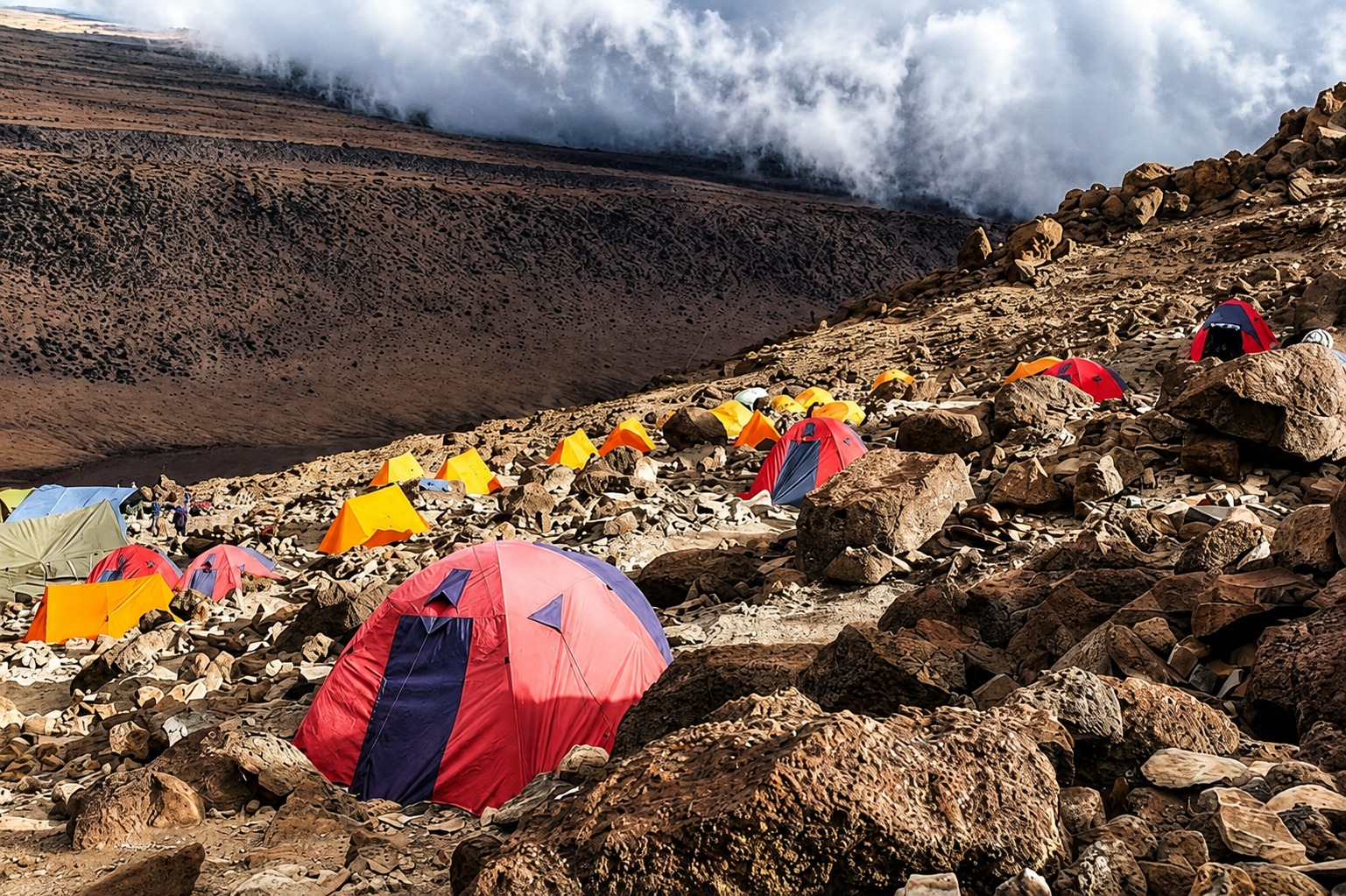
The Machame Route is one of Kilimanjaro's most popular climbing routes because of its varied landscapes, established camps, acclimatization opportunities, and scenic southern circuit. Climbers begin in the rainforest at Machame Gate and gradually ascend through heath, moorland, volcanic terrain, and alpine desert.
The seven-day itinerary is normally preferred to the six-day version because it allows the journey from Barranco to Barafu to be divided through Karanga Camp. This provides an additional day for acclimatization, recovery, and health monitoring before summit night.
A group joining climb follows a scheduled departure date. You join other travellers who have booked the same route and itinerary. Mountain guides, assistant guides, cooks, porters, camp staff, transport, meals, tents, and park arrangements are shared within the expedition.
Group joining departures can reduce the per-person cost compared with a private climb while creating a supportive social atmosphere. However, climbers should be comfortable sharing the itinerary, walking pace, meal times, camps, and daily schedule with other group members.
7 Days Machame Route at a Glance
Why Choose the 7-Day Machame Route?
Better Acclimatization
Seven days provide more altitude-adjustment time than the shorter six-day option.
Scenic Variety
The route crosses rainforest, moorland, volcanic valleys, alpine desert, and the summit zone.
Climb High, Sleep Lower
The Lava Tower to Barranco stage provides a valuable acclimatization pattern.
Separate Karanga Day
Karanga Camp helps divide the journey between Barranco and Barafu.
Barranco Wall
One of Kilimanjaro's most famous and memorable trekking sections.
Different Descent Route
Climbers descend through Mweka, creating a varied mountain journey.
Established Camps
Machame follows a well-known sequence of official mountain camps.
Strong Group Atmosphere
Shared goals and encouragement can improve the expedition experience.
Why Choose a Group Joining Kilimanjaro Climb?
Advantages of Group Joining
- Lower cost than many private departures
- Opportunity to meet international travellers
- Scheduled dates make planning easier
- Shared motivation during difficult sections
- Social dining and camp atmosphere
- Professional guide and porter support
- Good option for solo travellers
- Suitable for couples and small groups
Things to Consider
- Departure dates are fixed
- Group pace must be managed carefully
- Camp and meal schedules are shared
- Different climbers may have different fitness levels
- Group composition may be international
- Private itinerary changes may not be possible
- Single-tent supplements may cost extra
- Minimum departure numbers may apply
7 Days Machame Route Itinerary
Machame Gate to Machame Camp
After breakfast at your hotel, the climbing team transfers to Machame Gate. Registration, permit verification, crew organization, baggage checks, and final preparations take place before the trek begins.
The trail enters dense rainforest where conditions may be humid, muddy, and wet. Climbers walk beneath tall trees, mosses, ferns, and thick vegetation while gradually gaining elevation.
The first day can feel long because of the large elevation gain and uneven forest trail. Walking slowly from the beginning helps conserve energy and introduces the group to the “pole pole” pace used throughout the climb.
On arrival at Machame Camp, the crew provides drinking water, dinner, and a health briefing. Temperatures normally become cooler after sunset.
Meals: Lunch and dinner.Accommodation: Mountain tent at Machame Camp.
Machame Camp to Shira Camp
The trail leaves the rainforest and enters the heath and moorland zone. Vegetation becomes shorter and views open toward the Shira Plateau, Mount Meru, and the surrounding plains when conditions are clear.
Although the walking distance may appear moderate, the altitude gain is significant. The group continues at a slow and controlled pace with regular breaks.
Climbers may pass rocky ridges, volcanic formations, and exposed trail sections before reaching the Shira camp area. Afternoon cloud, wind, and colder temperatures are common.
An optional acclimatization walk may be arranged near camp, depending on time, weather, and group condition.
Meals: Breakfast, lunch, and dinner.Accommodation: Mountain tent at Shira Camp.
Shira Camp to Lava Tower and Barranco Camp
This is one of the most important acclimatization days on the Machame Route. The trail crosses the high alpine desert toward Lava Tower, a prominent volcanic formation at approximately 4,600 metres.
Climbers normally spend time near Lava Tower for lunch, rest, and altitude exposure before descending toward Barranco Camp.
The stage follows the principle of climbing high and sleeping lower. Even though Barranco is at a similar sleeping elevation to the previous camp, the body has been exposed to a much higher altitude during the day.
The descent enters the Barranco Valley, where giant groundsels and dramatic volcanic scenery may be visible. The imposing Barranco Wall rises above camp.
Meals: Breakfast, lunch, and dinner.Accommodation: Mountain tent at Barranco Camp.
Barranco Camp to Karanga Camp
The day begins with the climb of the Barranco Wall. The wall looks intimidating from camp, but it is normally completed as a guided scramble rather than a technical rock climb.
Climbers use hands for balance in selected sections and follow guide instructions through narrow or steep areas. The group should remain patient and allow enough space between climbers.
After reaching the top, the trail continues through a series of ridges and valleys with views of Kibo and the southern glaciers when weather permits.
The final section descends into Karanga Valley and climbs toward Karanga Camp. This separate camp day is a major advantage of the seven-day itinerary.
Meals: Breakfast, lunch, and dinner.Accommodation: Mountain tent at Karanga Camp.
Karanga Camp to Barafu Camp
The trail leaves Karanga and climbs steadily through an increasingly dry and exposed alpine environment toward Barafu Camp.
Barafu is the main high camp used for the Machame summit attempt. On arrival, climbers organize summit clothing, headlamps, snacks, water, gloves, batteries, trekking poles, and other essential equipment.
The guide conducts a detailed summit briefing covering departure time, clothing, pace, symptoms, route conditions, rest stops, and safety procedures.
Climbers should eat, drink, and rest during the afternoon. Sleep may be limited because summit preparation begins late in the evening.
Meals: Breakfast, lunch, and early dinner.Accommodation: Mountain tent at Barafu Camp.
Barafu Camp to Uhuru Peak and Mweka Camp
The summit attempt normally begins around midnight or shortly afterward. Climbers leave Barafu in darkness and ascend slowly through steep scree and frozen trail sections.
The group follows the guide's pace toward Stella Point on the crater rim. This is often the most physically and mentally demanding part of the climb.
From Stella Point, climbers continue around the crater rim toward Uhuru Peak. The final distance may appear short, but the extreme altitude makes every step demanding.
After photographs and a brief summit stay, the group descends to Barafu for food and rest. The descent then continues to Mweka Camp, creating a very long day.
Reaching the summit depends on health and safety. Guides may turn a climber around before Uhuru Peak if symptoms, exhaustion, weather, or trail conditions create unacceptable risk.
Meals: Breakfast, lunch, and dinner.Accommodation: Mountain tent at Mweka Camp.
Mweka Camp to Mweka Gate
After breakfast, the group completes the final descent through montane forest toward Mweka Gate.
The trail may be muddy and slippery, especially after rain. Trekking poles, careful foot placement, and controlled descending are useful.
At the gate, park procedures are completed and eligible climbers receive summit certificates according to the highest point reached.
The group meets the transfer vehicle and returns to the hotel for showers, rest, equipment organization, and an optional celebration.
Meals: Breakfast and lunch.Accommodation: Hotel, if included in package.
Daily Altitude, Distance and Walking Time
| Day | Route | Approximate Elevation | Estimated Time | Environment |
|---|---|---|---|---|
| Day 1 | Machame Gate to Machame Camp | 1,800 m to 3,000 m | 5–7 hours | Rainforest |
| Day 2 | Machame Camp to Shira Camp | 3,000 m to 3,840 m | 4–6 hours | Heath and moorland |
| Day 3 | Shira to Lava Tower to Barranco | 3,840 m to 4,600 m to 3,950 m | 6–8 hours | Alpine desert and valley |
| Day 4 | Barranco to Karanga | 3,950 m to 4,035 m | 4–5 hours | Rocky ridges and valleys |
| Day 5 | Karanga to Barafu | 4,035 m to 4,640 m | 4–5 hours | High alpine desert |
| Day 6 | Barafu to Uhuru Peak to Mweka | 4,640 m to 5,895 m to 3,100 m | 12–16 hours | Arctic summit and forest descent |
| Day 7 | Mweka Camp to Mweka Gate | 3,100 m to 1,640 m | 3–5 hours | Rainforest |
Machame Route Acclimatization Profile
The seven-day Machame Route is popular partly because it offers useful altitude variation. The most important acclimatization stage is the journey from Shira to Lava Tower and down to Barranco.
Gradual Early Ascent
The route begins in the forest and reaches high altitude over several days.
Lava Tower Exposure
Climbers reach approximately 4,600 metres before descending.
Karanga Camp
The seventh day allows a separate Karanga stage before Barafu.
Health Monitoring
Guides assess symptoms and overall condition throughout the route.
Estimated Summit Success
Seven-day Machame is generally associated with a stronger summit opportunity than six-day Machame because it includes more acclimatization and recovery time. However, no universal or guaranteed percentage applies to every operator and group.
Published success rates vary according to how success is defined, whether the figure refers only to Uhuru Peak, the number of climbers included, guide standards, itinerary design, season, and the physical profile of the group.
What Improves Summit Opportunity?
- Choosing the full seven-day itinerary
- Walking slowly from the first day
- Following guide instructions
- Eating enough despite reduced appetite
- Maintaining appropriate hydration
- Using suitable cold-weather equipment
- Completing structured training before arrival
- Reporting altitude symptoms honestly
- Sleeping and resting whenever possible
- Avoiding competition with other climbers
Group Joining Departure Information
Scheduled Dates
Group joining climbs operate on selected dates throughout the year. Travellers must arrive before the scheduled briefing and departure.
Shared Expedition
Group size depends on bookings, park procedures, guide ratios, and the operator's maximum group policy.
Easy to Join
Solo travellers can reserve one place without arranging a complete private team.
Price Information
Per person, based on the published group departure package and stated inclusions.
Price May Depend On
- Departure date
- Group size
- Hotel category
- Airport transfer arrangements
- Equipment rental
- Single tent request
- Portable toilet service
- Extra accommodation nights
- Safari or Zanzibar extensions
What's Included
Mountain Services
- Licensed Kilimanjaro mountain guide
- Assistant guides according to group size
- Mountain cook and support crew
- Porter support within permitted weight limits
- Machame Route park arrangements
- Mountain camping fees
- Rescue fee where applicable
- Group dining arrangements
- Sleeping tents
- Mountain meals
- Filtered or treated drinking water
Ground Services
- Pre-climb briefing
- Equipment inspection
- Transfer to Machame Gate
- Transfer from Mweka Gate
- Hotel accommodation if stated
- Airport transfer if stated
- Summit certificate for eligible climbers
- Emergency oxygen carried by the mountain team
- Pulse-oximeter monitoring where used
- First-aid support
What's Not Included
Personal Travel Costs
- International flights
- Tanzania visa
- Travel insurance
- Medical expenses
- Vaccinations and personal medication
- Meals not listed in the itinerary
- Personal snacks and drinks
- Hotel upgrades
Optional or Personal Items
- Guide, porter, and cook tips
- Personal trekking equipment
- Sleeping bag rental
- Private portable toilet unless stated
- Single-room or single-tent supplement
- Extra hotel nights
- Laundry services
- Safari and Zanzibar extensions
Mountain Accommodation
The Machame Route uses mountain camps. Climbers sleep in tents while the support crew manages camp setup, food preparation, water, and baggage transportation.
Sleeping Tents
Usually shared by two climbers unless a single-tent supplement is arranged.
Sleeping Mats
Basic mountain sleeping mats may be supplied according to the package.
Dining Arrangement
Meals are served in a shared dining tent or designated camp eating area.
Toilets
Public camp toilets are available. Private portable toilets may be offered at extra cost.
No Showers
Full showers are generally unavailable on the mountain.
Cold Nights
Temperatures can fall below freezing at higher camps.
Meals on the Mountain
Mountain meals are designed to provide energy during long trekking days. Menus vary by operator, availability, group dietary needs, and mountain conditions.
| Meal | Possible Examples |
|---|---|
| Breakfast | Porridge, eggs, bread, fruit, pancakes, tea, coffee, and hot chocolate |
| Lunch | Soup, sandwiches, rice, pasta, potatoes, vegetables, chicken, fruit, or packed lunch items |
| Dinner | Soup, rice, pasta, potatoes, vegetables, meat, stew, fruit, and dessert |
| Trail Snacks | Climbers should carry personal energy bars, sweets, nuts, gels, or preferred snacks |
| Drinks | Drinking water and selected hot drinks at camp |
Physical Fitness Requirements
The Machame Route does not require technical climbing experience, but it requires strong walking endurance, leg strength, mental resilience, and the ability to recover during consecutive trekking days.
Cardiovascular Fitness
Required for long uphill walking and reduced oxygen at altitude.
Leg Strength
Important for steep climbing, Barranco Wall, and long descents.
Core Stability
Helps maintain balance with a daypack on uneven terrain.
Mental Endurance
Essential during summit night, cold weather, and fatigue.
Recommended Training Plan
- Begin structured training eight to twelve weeks before departure.
- Complete regular walking, hiking, cycling, or aerobic exercise.
- Increase weekly training gradually.
- Complete long weekend hikes.
- Practise back-to-back hiking days.
- Use stairs or an inclined treadmill.
- Train with your trekking boots.
- Carry a realistic daypack.
- Use trekking poles during training.
- Strengthen the quadriceps, glutes, calves, hips, and core.
- Practise controlled downhill movement.
- Taper training during the final week.
Essential Packing List
Clothing
- Moisture-wicking base layers
- Warm mid layers
- Insulated summit jacket
- Waterproof jacket
- Waterproof trousers
- Trekking trousers
- Warm summit trousers
- Thermal underwear
- Warm hat
- Sun hat
- Buff or neck gaiter
Footwear and Hands
- Broken-in waterproof trekking boots
- Camp shoes or sandals
- Trekking socks
- Liner socks
- Warm summit socks
- Light gloves
- Insulated summit gloves
- Gaiters
- Blister treatment
- Foot-care supplies
Equipment
- Cold-rated sleeping bag
- Daypack with rain cover
- Duffel bag
- Trekking poles
- Headlamp and spare batteries
- Water bottles or hydration system
- Sunglasses
- Sunscreen
- Personal first-aid items
- Dry bags or waterproof liners
Best Time to Join the Machame Route
| Period | General Conditions | Group Joining Notes |
|---|---|---|
| January to early March | Often drier with relatively warm daytime conditions | Popular period with regular departures |
| March to May | Long-rain period with mud, rain, cloud, and wet equipment | Fewer scheduled groups may operate |
| June to October | Main dry season with colder nights | High demand and busy camps |
| November | Short-rain period with variable conditions | Departures may be available at selected dates |
| December | Variable weather and holiday demand | Christmas and New Year departures may fill early |
Altitude Sickness and Safety
Kilimanjaro's summit is at extreme altitude. Acute mountain sickness can affect any climber regardless of age, previous fitness, or training background.
Common Symptoms
Headache, nausea, dizziness, poor appetite, fatigue, and disturbed sleep.
Serious Symptoms
Confusion, loss of coordination, breathlessness at rest, repeated vomiting, or severe weakness.
Required Action
Report symptoms immediately and follow the guide's decision, including descent when necessary.
Guide, Porter and Cook Team
The mountain crew is central to the success and safety of the expedition. Crew size depends on the number of climbers, guide ratios, equipment, food, route, and porter weight regulations.
Lead Guide
Manages the itinerary, pace, health checks, safety, and summit decisions.
Assistant Guides
Support smaller walking groups and help manage different speeds.
Mountain Cook
Prepares meals and coordinates food supplies.
Porters
Carry approved group equipment, tents, food, and climber duffel bags.
Group Joining Rules and Expectations
- Arrive before the scheduled briefing time.
- Bring all required travel documents.
- Attend the equipment inspection.
- Respect the guide's walking pace.
- Report health concerns honestly.
- Respect other group members.
- Follow camp and park regulations.
- Keep luggage within the permitted porter weight.
- Avoid loud behaviour at camps.
- Do not pressure unwell climbers to continue.
- Follow environmental and waste-management rules.
- Understand that the guide controls safety decisions.
Frequently Asked Questions
What is a Kilimanjaro group joining climb?
It is a scheduled climb where travellers book individual places and share the expedition with other climbers.
Is the seven-day Machame Route suitable for beginners?
Yes, physically prepared beginners can join, although the climb remains challenging because of altitude, cold, and long walking days.
Is seven days better than six days?
Seven days generally provides more acclimatization and recovery time by adding a separate Karanga Camp stage.
What is the highest point?
Uhuru Peak at 5,895 metres or 19,341 feet.
Do I need climbing experience?
Technical climbing experience is not required, but trekking fitness and preparation are necessary.
Do I need ropes or climbing equipment?
Standard Machame trekking normally does not require ropes, harnesses, or technical climbing equipment.
How difficult is the Barranco Wall?
It is a steep guided scramble. Most climbers complete it without technical climbing skills.
Is the Machame Route crowded?
It can be busy during popular climbing seasons because it is one of Kilimanjaro's most frequently selected routes.
Where do climbers sleep?
Climbers sleep in mountain tents at official camps.
Are there showers on the mountain?
Full showers are generally unavailable. Warm washing water may be provided at camp.
Are toilets available?
Public toilets are available at camps. Private portable toilets may be offered at additional cost.
Can solo travellers join?
Yes. Group joining departures are particularly suitable for solo travellers.
Can couples join?
Yes. Couples can reserve two places in the same scheduled group.
What happens if the group walks at different speeds?
Assistant guides may help manage different pace groups, depending on group size and staffing.
What happens if I become sick?
The guide assesses your condition and may stop your ascent or arrange descent when required.
Is emergency oxygen carried?
Reputable operators normally carry emergency oxygen, but it is not a substitute for descent.
Can I rent trekking equipment?
Many operators offer equipment rental. Availability and prices should be confirmed before arrival.
How much luggage can a porter carry?
Personal duffel weight is restricted. Confirm the operator's permitted limit before packing.
Do I carry my own bag?
You normally carry a daypack with water, clothing, snacks, camera, rainwear, and personal essentials.
What does the porter carry?
Porters carry approved duffel bags and group equipment within regulated weight limits.
How cold does it get?
High camps and the summit can fall well below freezing, especially before sunrise.
What is the best time to climb?
January to early March and June to October are commonly selected because conditions are generally drier.
Can I climb during the rainy season?
Yes, but trails may be muddy, wet, slippery, and cloudy.
Are vegetarian meals available?
Usually yes, provided the request is made before the climb.
Is drinking water provided?
Mountain water is normally collected and treated or filtered by the crew.
Should I use a hydration bladder?
It can be useful during lower stages, but hoses may freeze near the summit. Bottles should also be carried.
Can I charge my phone?
Charging facilities are generally unavailable. Bring power banks and spare batteries.
Is there mobile network coverage?
Coverage is inconsistent and should not be relied upon.
Do I need travel insurance?
Yes. Insurance should cover trekking up to the maximum altitude and emergency evacuation.
Are tips included?
Tips are normally excluded unless clearly stated in the package.
Can I request a single tent?
Yes, subject to availability and an additional supplement.
What happens if I do not reach the summit?
Safety takes priority. You may receive a certificate for a recognized crater-rim point if reached, according to park procedures.
Can summit success be guaranteed?
No responsible guide or operator can guarantee the summit.
Can I combine the climb with a safari?
Yes. Many travellers add Serengeti, Ngorongoro, Tarangire, Lake Manyara, or other destinations.
Can I visit Zanzibar after the climb?
Yes. Zanzibar is a popular post-climb extension.
How early should I book?
Book early for peak seasons, holiday departures, flights, equipment, and hotel availability.
What documents are required?
A valid passport, visa where required, insurance details, medical information, and booking documents may be needed.
Where does the climb start?
The mountain trek starts at Machame Gate after transfer from your hotel.
Where does the climb finish?
The trek finishes at Mweka Gate.
Why descend through Mweka?
The Machame itinerary uses Mweka as its main descent route, creating a different return journey from the ascent.
What does “pole pole” mean?
It means “slowly, slowly” in Swahili and describes the steady pace used on Kilimanjaro.
Is this climb suitable for children?
Age restrictions, fitness, health, maturity, insurance, and park rules must be reviewed before booking.
Can older travellers join?
Yes, when medically fit, properly prepared, and approved for high-altitude trekking.
Will the departure operate with one person?
Minimum numbers may apply. Confirm the departure guarantee and private-climb alternative before booking flights.
Can I change a group climb to a private climb?
This may be possible before departure, subject to availability and revised pricing.
Join the Best 7-Day Machame Route Group Climb
Reserve your place on a scheduled Kilimanjaro Machame Route departure and climb with professional guides, porters, cooks, and fellow travellers from around the world.
Request the latest departure dates, confirmed package price, group size, hotel options, airport transfers, equipment rental, payment terms, cancellation policy, and safari or Zanzibar extensions.
Book Your Group Climb Request Departure Dates


.png)
.png)
.png)


.jpg)
.jpg)
.jpg)

